There is one mistake law firms make over and over when they decide to advertise to Spanish-speaking clients: they take marketing created for an English-speaking audience, translate it into Spanish, and assume they now have a Spanish marketing campaign. The billboard is the same. The website is the same. The Google Ads are the same. The landing pages are the same. The message is the same. The strategy is the same. The only thing that changed was the language. Then, when the campaign fails to generate the calls, cases, or engagement the firm expected, someone concludes that Spanish advertising does not work. The problem may not be the Latino market. The problem may be that the law firm never actually marketed to it.
Spanish-speaking consumers are not simply English-speaking consumers who happen to prefer different words. Language affects communication, but culture, community, trust, family, geography, search behavior, familiarity, immigration history, generation, and personal experience can all influence how someone chooses a law firm. The U.S. Latino population itself is extraordinarily diverse, including people with roots throughout Mexico, Central America, South America, Puerto Rico, Cuba, the Dominican Republic, and other parts of the Caribbean, along with millions of second- and third-generation Americans. Some consumers primarily speak Spanish. Some move comfortably between Spanish and English. Some search for legal information in Spanish but conduct business in English. Others may speak English fluently while still responding strongly to brands that understand and communicate authentically with Latino communities. There is no single Latino consumer, which is precisely why a copy-and-paste advertising strategy is so dangerous.
The mistake begins with the assumption that translation equals communication. It does not. Translation answers the question, “How do we say these words in Spanish?” Effective Latino legal marketing asks something much larger: “How do we communicate this message in a way that is relevant, natural, credible, and useful to the people we are trying to reach?” A technically perfect translation can still produce terrible marketing. The words may be grammatically correct while the message feels unnatural. The advertisement may make sense linguistically while failing culturally. The call to action may be translated correctly while doing nothing to establish confidence. This is the difference between translation and localization, and law firms that want to reach Spanish-speaking clients need to understand it.
Localization considers the entire experience. It looks at vocabulary, tone, regional differences, imagery, questions, concerns, search terms, calls to action, attorney presentation, and the way legal information is explained. A law firm marketing to Spanish-speaking accident victims in Miami may be speaking to a very different mix of communities than a firm in Phoenix, Las Vegas, Houston, Los Angeles, Chicago, or New York. That does not mean every advertisement needs to be rewritten for every nationality. It means marketers need to understand that Spanish is a language connecting many communities, not a single culture that can be reduced to one advertising template.
The same mistake appears constantly in Spanish SEO for law firms. A personal injury firm may rank for “car accident lawyer near me” and assume its Spanish strategy should simply target a literal translation of that phrase. But real consumers do not search according to a marketing department’s translation spreadsheet. Someone might search for “abogado de accidentes cerca de mí,” “abogado de accidentes de carro,” “abogado de accidente de auto,” “abogado de lesiones personales,” or ask Google an entire question about what to do after a collision. Search terminology can vary by region, background, and familiarity with the American legal system. If your Spanish keyword strategy begins and ends with translating your English keywords, you may be optimizing for the words you assume people use instead of the words they actually type.
That difference becomes even more important as search evolves beyond traditional Google results. Potential clients are increasingly discovering information through YouTube, social media, maps, directories, video, AI-powered search experiences, and conversational questions. Someone may not search for “personal injury attorney” at all. They may ask, “¿Qué hago si me chocaron y no tengo seguro?” or “¿Quién paga mis gastos médicos después de un accidente?” or “¿Necesito un abogado después de un accidente de carro?” The law firm that answers those questions clearly and consistently has an opportunity to become useful before it ever asks someone to become a client.
That is an important shift because some law firms advertise almost entirely around themselves. We win. We fight. We have recovered millions. Call us today. Those messages can have a place in legal advertising, but they should not be the entire strategy. A person who has just been injured may be asking very different questions. What happens now? Can I afford medical treatment? What if I cannot work? Should I speak with the insurance company? Is the consultation free? Will someone at the firm understand me? How does the legal process work? Can someone explain this to my family? Effective marketing to Spanish-speaking legal clients should address the client’s uncertainty, not simply translate the firm’s accomplishments.
This is where trust becomes one of the most important differences between advertising and actual market development. You can purchase an impression. You can purchase a click. You can purchase a billboard. You can purchase a television spot. You cannot purchase trust nearly as easily. Trust develops when the promises made by the advertising are supported by the experience that follows. If your Spanish advertisement tells people that your firm understands them, the website should reinforce that message. If your website invites Spanish-speaking clients to call, the person answering should be able to communicate with them. If your marketing says the firm is accessible to Latino clients, the intake process, follow-up, case communication, and client experience should demonstrate it.
This is where some expensive Spanish advertising campaigns quietly fall apart. The marketing agency generates a Spanish lead. The advertisement works. The person clicks. The landing page works. The potential client calls. Then the firm’s infrastructure fails. Nobody immediately available speaks Spanish. The caller gets transferred repeatedly. Someone promises a callback. The follow-up arrives in English. A bilingual employee happens to be at lunch. The caller hangs up and contacts another firm. From the marketing report, that may look like a poor-quality lead. From the potential client’s perspective, the law firm simply was not prepared for them.
A successful Spanish advertising strategy therefore cannot be separated from bilingual law firm intake. If a firm intends to invest seriously in attracting Spanish-speaking clients, it should invest seriously in serving them. That may include bilingual intake specialists, Spanish-speaking case managers, professional interpretation when appropriate, Spanish text and email communication, translated client resources, clear internal procedures, and staff training. Marketing should never make a promise that operations cannot keep.
There is another mistake hidden inside many campaigns: the assumption that adding obvious Latino imagery automatically makes an advertisement culturally relevant. A stock photograph of a Latino family does not create cultural competence. Neither does putting a Mexican flag behind an attorney, adding Spanish music to a commercial, or using exaggerated cultural imagery. In some situations, those choices can actually make marketing feel less authentic. Cultural relevance is not decoration. It comes from understanding the audience well enough to communicate naturally and respectfully.
Sometimes the most culturally relevant marketing does not look “ethnic” at all. It simply speaks clearly, answers the right questions, uses natural language, represents people authentically, removes unnecessary barriers, and demonstrates that the firm understands the community it serves. That approach may not scream “Latino marketing,” but it can create something much more valuable: connection.
Law firms also need to recognize the difference between advertising to Latino consumers and building a brand within the Latino market. Advertising rents attention. Branding builds recognition. A Google Ad may generate a call today, but a broader strategy can make the firm’s name familiar long before someone needs an attorney. Spanish-language educational content, social media, YouTube videos, local SEO, community partnerships, directories, attorney profiles, podcasts, interviews, sponsorships, and useful legal resources can all contribute to that familiarity.
This matters tremendously in personal injury marketing because the moment someone needs an attorney is unpredictable. Nobody schedules a car accident for next Tuesday. When the accident happens, the firms with an existing relationship with the market can have an advantage. If someone has already seen your videos, encountered your social media, read your articles, heard your name, or knows someone who recognizes your firm, the decision may not begin with ten complete strangers on Google. Your firm may already be one of the names they consider.
That is market positioning, and it cannot be translated into existence.
It has to be built.
The firms that understand this are likely to approach Latino legal marketing very differently. Instead of asking, “Can we translate our ads into Spanish?” they will ask, “How do Spanish-speaking consumers in our market discover attorneys?” Instead of asking, “Can we translate our website?” they will ask, “What information are people searching for in Spanish?” Instead of asking, “Can someone answer the phone in Spanish?” they will ask, “Can we provide a consistently excellent bilingual client experience?” Instead of asking, “How do we get Spanish leads?” they will ask, “How do we become a trusted legal brand within this market?”
That final question changes everything.
It changes how you build the website. It changes how you conduct keyword research. It changes the articles you publish. It changes your videos. It changes your social media. It changes your intake process. It changes the people you hire. It changes how you measure success. Most importantly, it moves the objective beyond generating occasional Spanish-language leads and toward developing long-term authority within the Latino market.
There is also a competitive reason law firms should make that shift now. As more attorneys recognize the opportunity presented by Latino consumers, Spanish-language personal injury marketing will become increasingly crowded. More firms will launch Spanish websites. More will invest in Spanish Google Ads. More will create Spanish social media content. More will hire bilingual intake teams. More will compete for searches such as abogado de accidentes, abogado de lesiones personales, abogado de accidentes de auto, abogado de accidentes cerca de mí, and hundreds of related questions.
When that happens, simply being available in Spanish will no longer be a meaningful competitive advantage.
The question will become: Which firms have earned the strongest position?
The answer is unlikely to be the firm that translated the most advertisements. It will be the firm that built visibility, trust, relevance, accessibility, reputation, and recognition over time.
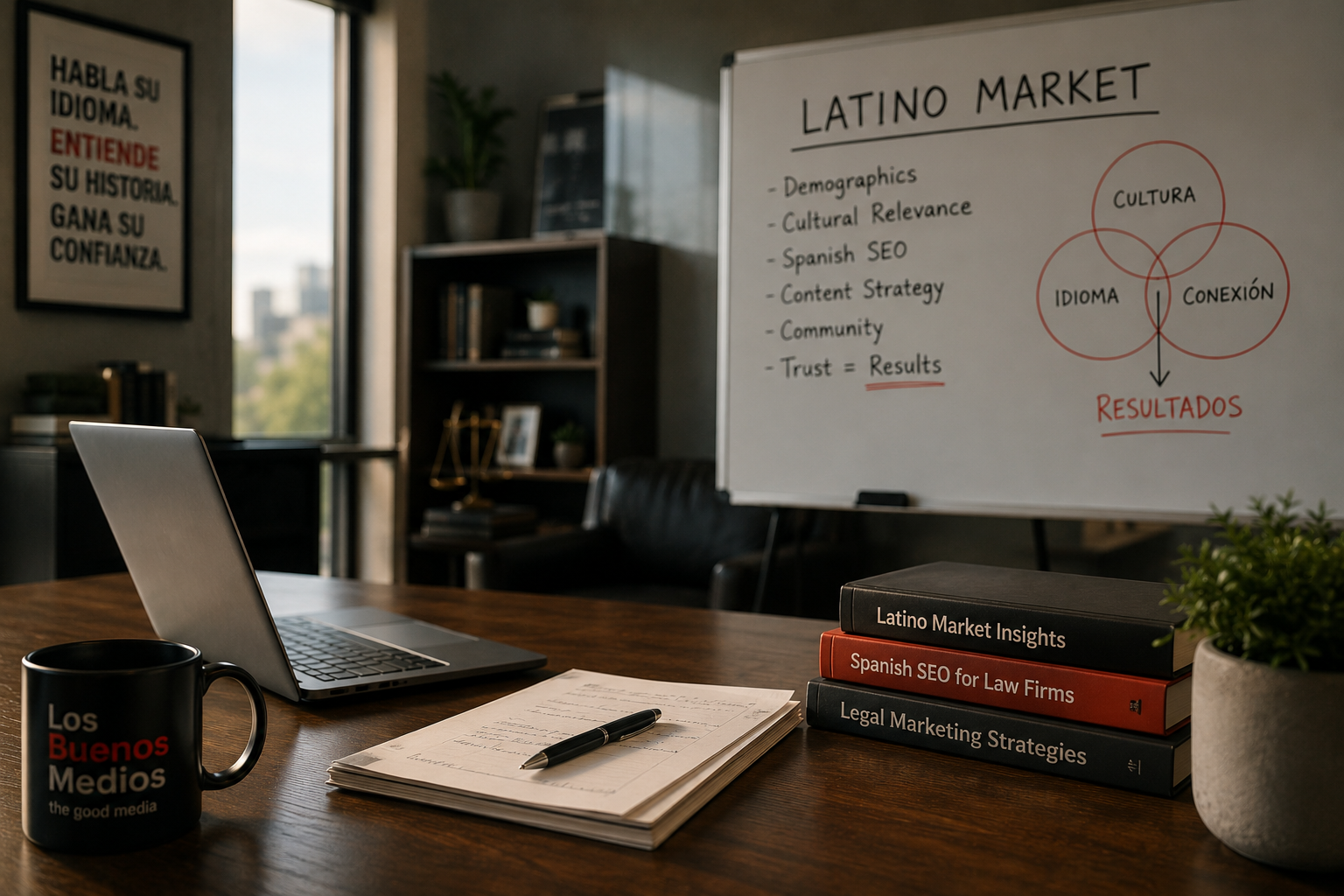
At Los Buenos Medios, this is why we believe law firms should stop viewing Spanish marketing as an English campaign with different words. Translation matters. Spanish-speaking staff matter. Spanish websites matter. But those things should operate inside a larger strategy that includes Spanish SEO, culturally relevant content, bilingual intake, social media, video, branding, local visibility, community engagement, reputation, and long-term Latino market positioning.
If your law firm wants to reach Spanish-speaking clients, don’t begin by asking how quickly you can translate your current advertising.
Begin by asking who you are trying to reach.
Understand how they search. Understand what they need to know. Understand what creates confidence. Understand what happens after they call. Build the infrastructure to serve them. Create content specifically for them. Show up consistently. Earn familiarity. Earn credibility. And then build advertising around that foundation.
Because the biggest mistake law firms make when advertising to Spanish-speaking clients isn’t bad Spanish.
It’s assuming that changing the language means you changed the strategy.
Reaching Your Clients Doesn’t Have To Be Difficult

Reaching the Latino market doesn’t have to be complicated—but it does need to be intentional. At Los Buenos Medios, we help attorneys move beyond simple translation and build marketing strategies designed around visibility, cultural relevance, trust, and real connection. From Spanish SEO and localized websites to content, social media, branding, video, and long-term market positioning, we help your law firm reach the people you want to serve in ways that feel authentic and make sense for your market. You already know how to be a great attorney. Let us help make sure the Latino community knows who you are. Reach out to Los Buenos Medios and let’s start the conversation.